• Finding Voice Through Materials: When Words Fail, Making Speaks

    I wish I could craft words as easily and intuitively as I shape beeswax with my hands. Words on a white page have always seemed too stark to me, too crude to describe a life lived. I didn’t learn to read until late into primary school..written words were baffling to me. Despite this struggle, I’d communicated with my twin sister through some sort of unique language from an incredibly early age.

    But what I’m coming to realise is that I can approach writing with the same freedom I create art with. I was naive to think that you start writing with words. Instead, you start a piece of writing by forming images in your mind. Memories and experiences leave imprints that sometimes we don’t even remember are there until we look for them. I piece these fragments together, build language from their invisible parts- creating form from the formless experience of things.

    Maybe there aren’t words to describe this process adequately and that’s why I make art.

    I grew up dyslexic, struggling to read, developing secret strategies to hide and cope. I couldn’t write the number 8, so I made it from two circles instead. Selective mutism. Trauma I didn’t have language for. My throat was “paved with glass” – that’s how it felt when I tried to speak in class. Words failed me, literally failed me as a child who couldn’t speak, whose throat closed up, who learned to survive by staying quiet. When I was little, my twin sister and I had two toy plastic spiders. We named them “Good” and “Bad.” Good no longer squeaked when you pressed it as the squeaking mechanism had broken inside it. Bad still made noise.

    My twin sister and I were born premature – seven or eight weeks early, half-formed, undeveloped. We lived with undiagnosed vision problems until halfway through Art School. We’d been capturing life on half focus, seeing the world through blurred vision, accepting a mumbled word instead of a clear voice. When we finally got contact lenses, suddenly our drawing became way more detailed. I have no idea if that was an improvement. We’d been living in soft focus our whole lives and it was a protective filter through which to view the world.

    And now I’m making work about bringing things into focus. Giving form to what was blurred. Preserving light through dark winters. Refusing to let things be pinned down and flattened like traditional herbarium specimens.

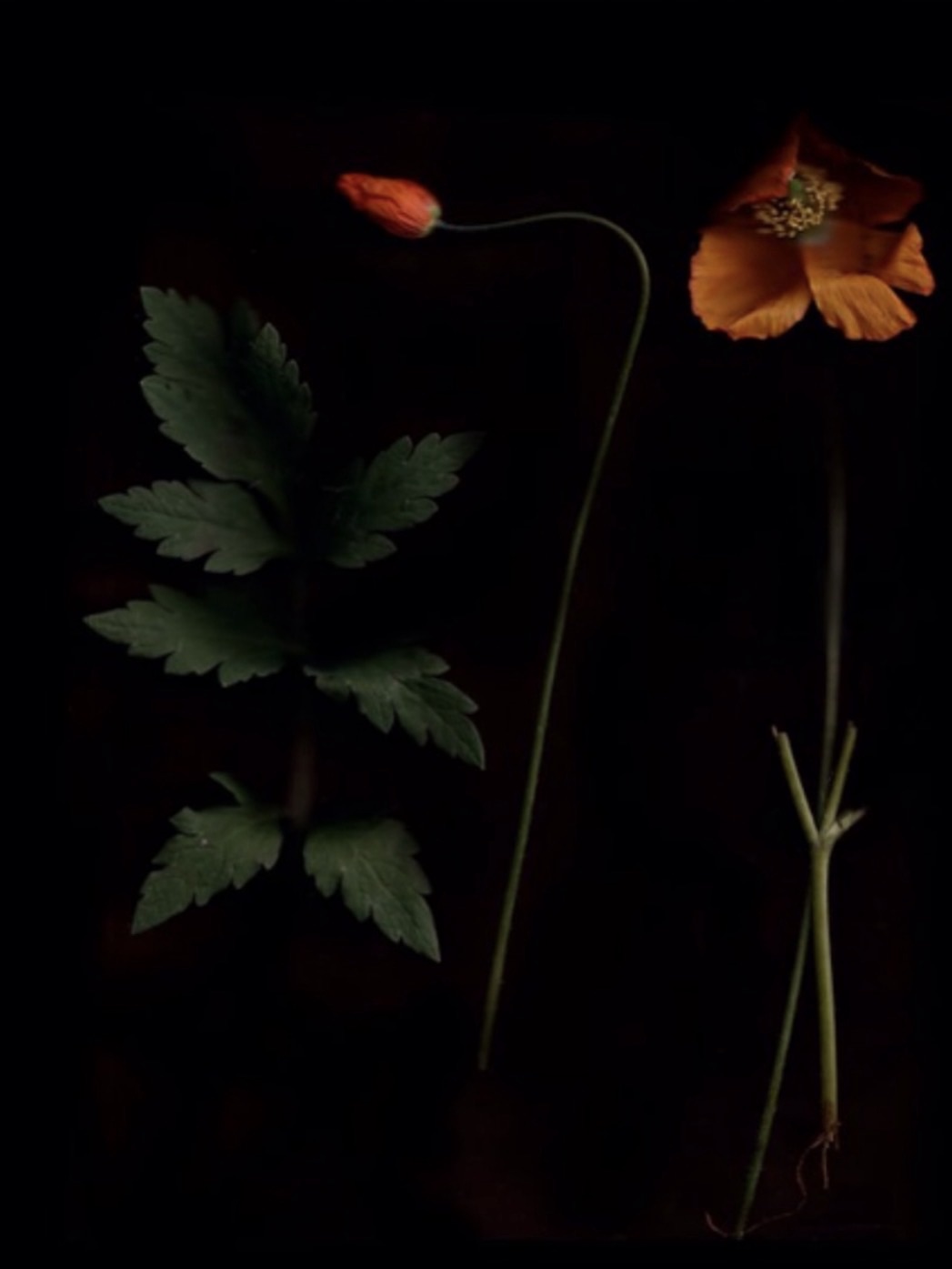
    The botanicals with curled edges that won’t stay flat on the scanner – that’s me. That’s my twin. That’s refusing to be contained, classified, made neat and presentable.

    I press botanicals between two pieces of paper and take graphite impressions of both surfaces – both sides of the plant at once. This is like being a twin. Two impressions of the same thing, mirror images, shadows of each other. The visible and the invisible happening simultaneously. The side that faces light and the side that lives in shadow.

    The ghostly layers, the half-formed identities, the things that curl away – of course this is my aesthetic. I’m working with memory, with childhood, with premature birth and blurred vision. Ghostly is honest.

    I studied anatomy and physiology in my nursing degree. When I look at plant roots, I see blood vessels. When I look at leaves, I see loom-like structures, weaving systems. The plant looking up toward the sun like a head. This isn’t metaphor – this is how I actually perceive the world. I see the anatomical structures, the life systems, the vessels that carry sustenance.

    The hoarding of dried flowers, the obsession with my bees storing light and pollen for winter – I’m doing the same thing. Storing life force. Trying to hold onto summer, onto light, onto the feeling of being alive when everything else feels overwhelming and half-formed.

    My work gives voice to voiceless things. Plants can’t speak. Premature babies in incubators can’t speak. The domestic labor of mothers, the invisible care work – it doesn’t speak either, doesn’t count as “earning money,” exists in the background while other people’s businesses run on “his” family’s land.

    Materials became my language. Beeswax, graphite, botanicals, creased Polaroid photos – these are how I speak. When words failed me, my hands learned a different vocabulary. The slow, contemplative process of layering encaustic. The patient documentation of each botanical specimen. The voice notes I record while working, capturing thoughts that would otherwise be lost.

    This is my voice. Not articulate in the way galleries might expect. Not easily digestible in a wall text. But honest. Embodied. Real.

    The work isn’t about explaining. It’s about witnessing. About refusing to let things disappear into darkness. About preservation that honours wildness rather than containment.

    So when you look at the curled edges, the ghostly layers, the botanical specimens that refuse to lie flat – you’re seeing voice. Just not made from words.
  • Failure: Walking The Tightrope and Finding Balance.

    Introduction

    Back in week three, our MA discussion focused on failure – what it is, why it stings, and how to use it. We explored why personal mistakes feel threatening, why we often learn more easily from other people’s missteps. I’ve also been thinking about learning and how it’s so intricately mediated by our nervous systems.


    In my process-led practice I loop between making, thinking, rethinking, and making again. Failure isn’t a detour in that loop – it’s part of the road.

    “Those who say ‘yes’ are rewarded by the adventures they have. Those who say ‘no’ are rewarded by the safety they attain.” ~Keith Johnstone

    I want to choose “yes” more often, even when my nervous system finds it uncomfortable.

    Experimenting: Sweet Pea plant painted with graphite & pressed onto translucent Japanese paper. So many air bubbles under it once in encaustic so I peeled it back off. Love the fragile imprint of the leaf veins though. Will try without using paper- straight into encaustic.

    Failure can teach us but only if we’re receptive.

    • Ego gets in the way. When something flops, my self-esteem can tip into fight-or-flight. The urge is to defend, ignore, or run from the data.
    • We forget what we got wrong. My instinct is to move on quickly instead of tracing the exact moment things drifted.
    • School trains us to be right. A lifetime of correct answers makes experiments feel risky.
    • Identification tightens the grip. If I’m over-attached to being “a good artist” or to a fixed outcome, any wobble feels like a threat.

    Third-Person Reflection: Finding Distance From “Failure”

    We each wrote, in the third person, about something we’d failed at. I described how the Scottish school holidays – and the chaos they bring – disrupted my normal working hours. Writing it as a short report helped: she tried to timetable studio time, the day dissolved into childcare and logistics, so the making slid to late nights.
    That third-person distance stopped the usual self-berating and shifted me into analysis instead. A practical plan emerged: I need to balance the reality of odd-hour work with deliberate time to step away from conscious art thinking, so ideas can process. In other words, keep what works about late sessions, but pair them with recovery and incubation time – a kinder rhythm that sustains the practice.

    A Behavior-Change Lens- A cyclical process.

    Prochaska & DiClemente’s model of behaviour change from my (far distant) nursing studies reminds me that change is circular, not linear:

    Pre-contemplation → Contemplation → Preparation → Action → Maintenance → Relapse/Recycle → back with more information.

    Seeing failure inside a loop helps me welcome unpredictability without panic and choose one compassionate next step.
    Donald Schön’s reflective practice model works the same way: we learn in moments of surprise, puzzlement, or confusion by pausing to reflect and then trying a small experiment. I recognise that well worn path in my studio: make – notice – adjust – try again.

    It’s all in the mind.

    Research suggests we’re surprisingly bad at learning from our own mistakes. When something goes wrong, the fight-or-flight response (sympathetic nervous system) can kick in, with the amygdala helping detect threat and initiate the body’s protective stress response. In that state we tend to defend, dismiss, or rush past the data. Conversely, when our bodies are in the rest & restore mode (parasympathetic nervous system activation) reflection and learning from our experiences happens far more effectively.

    Interestingly, people are more open to learning from other people’s mistakes. There’s built-in psychological distance: no felt shame, less self-blame, more curiosity.
    The lesson: if distance helps, we can create it for ourselves.
    While I’m making art, I observe my mind judging, and identifying whether my efforts are successful or not. When I notice this happening, I intentionally try to loosen identification with the perceived outcome I’m working towards. The paradigm shifts. I give myself permission to explore rather than produce. The pressure of the logical mind lifts and another part of my nervous system takes charge. The spontaneous concentration I often experience during this free flowing process allows me to respond to what’s happening in front of me, without the need to constantly intellectualise my every move. It’s more a physical process of senses, materials and looking. Often, there isn’t time to think and plan things through. It’s almost as if too many thoughts during this process is a hindrance.

    However, when I approach making with ‘wrong’ frame of mind things rarely run so smoothly. There! I admitted it. Maybe there are “rights” and “wrongs” in my making- but they are entirely to do with the attitude I bring to the process rather than the outcome.

    It’s like dancing along a tight rope- there needs to be a balance of playfulness on one hand, but with a sense of direction. It’s not just experimentation- it’s experimentation with purpose. It’s about I need to be ready to respond to that sway of the tightrope the second it moves- recalibrate, rebalance while moving in a forward direction. I’m also learning that falling, and having to start the process again is not a failure. Muscle memory retains every so-called mistake and strengthens my ability to respond the next time I feel the rope move under my feet.

    Beeswax is sun bleached, filtered and heated with crushed damar resin.
    The bloom on the surface tells me the beeswax & damar resin have mixed properly.
    I saw this squash plant which had been discarded on the compost head. Of course I plan to press it and create a huge graphite print of all its beautiful tendrils & ragged leaves. to embed in wax.
    Exploring graphite ghosts.
    Painting found bottle with graphite.
    I’ve been digging old bottles out of the woods! These are for cyanotypes which I’ll layer in the encaustic.

    Failure as a Public Good

    A line from our course notes stayed with me: “The info in failure is a public good. When it is shared, society benefits.”
    I love this. It shifts failing from a private shame to a shared resource. When artists publish process notes, tests, and dead ends, the field moves forward. It also builds a culture where trying something that might not work is normal, not hidden from view. I’m realising how important it is to have the courage to experiment in my practice.

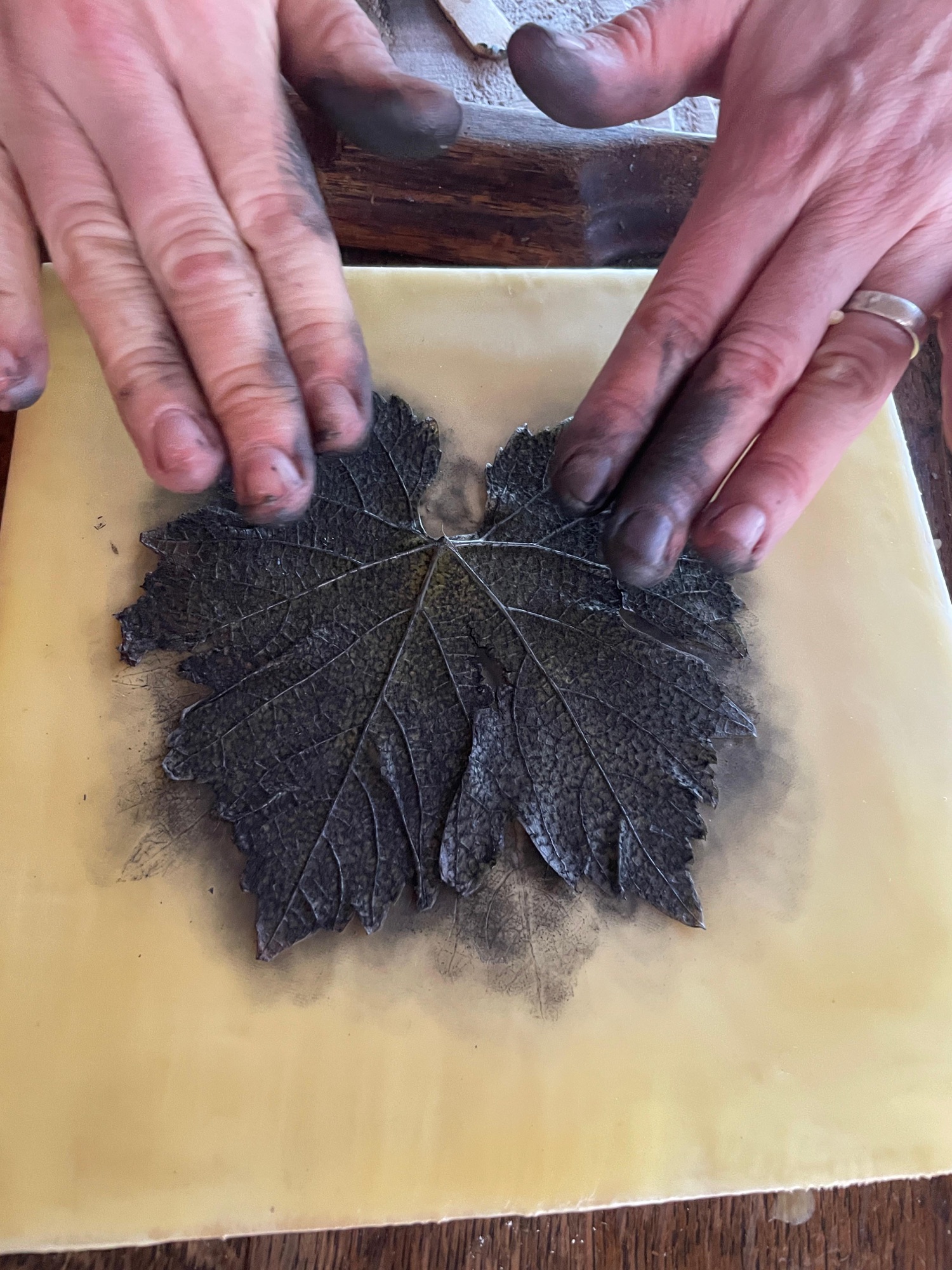
    Gradients of graphite from Grape leaf imprint on encaustic. I’d like the beeswax to be paler but I’m really happy with the texture & ghostly layers.

    Failure brings progress.

    Rather than betting the whole project each time, I’m leaning into small, cheap, reversible tests – just enough risk to learn, not enough to paralyse.

    I’ve been experimenting so much recently that there are too many failures to mention. I’m really surprised by the headway I feel I’ve made though. Small test boards of encaustic (beeswax courtesy of my bees & damar resin) felt intimidating & too delicate to touch at first. After a few days of experimenting, I realised that the multiple layers of medium were just the dynamic surface I’d been searching for. I needed a surface that could hold fine detail, be layered up and scraped back quickly, while embodying the qualities of light in solid form. Beeswax is such an incredibly forgiving and malleable material. It invites touch and holds the scent of pollen, nectar and propolis once stored within it. Each batch of wax is unique in colour & scent.

    An encaustic surface can record the smallest most delicate imprints – fingerprints, plant tendrils and leaf skeletons are recorded with intricate detail. Beeswax is naturally adhesive- especially given hives are often full of propolis (bee-glue made by bees chewing sticky tree resin). While the encaustic is warm, this stickiness can grab pigment really nicely. Soluble graphite powder is a new discovery that works really well for this process. Initially the graphite is beautifully encased in a ghostly layer of wax but if the wax is heated beyond melting point, the graphite dispenses into the wax and starts to have a life of its own. Much like blooms in watercolour paint. I plan to explore this beautiful and unexpected movement of the graphite within the wax. The versatility of having a medium that can be worked both as a liquid, and a semi solid surface is very interesting . Not only this but once cured, encaustic hardens, protects and illuminates the materials buried within it.

    Grape leaf painted with soluble graphite and pressed into encaustic. A ghostly imprint remains.

    Oak gall ink will be mixed with graphite instead of using water to create a subtle sepia.
    One plant, two prints. I’ve also been pressing huge rhubarb leaves for the same purpose.
    Failure is messy.
  • The next phase was Musselburgh. Plucked from teuchter life and dropped into a council house on the edge of Edinburgh. No more sheep shit. Just slabs and snails. Still wet, still wild in its own way.

    We found snails in the garden like treasure. We hunted them in the undergrowth, noses to the earth, breathing in that sharp green smell that only city soil has – something damp and secretive. I remember the smell more than the snails. It lives in me like a basement.

    I had a plastic tractor and trailer we’d brought from Scourie. The front wheel snapped right off, so it got welded back on – backwards. I didn’t care. It still moved. It still carried things. So did I.

    We walked to school along little paths – narrow like the Highland roads we’d left behind, but now scattered with glass and crisp packets. The wildness was still there, just broken up and littered. It had corners instead of curves.

    Me and Kirsty were sensitive. Extra soft. Twin-soft. So shy we barely spoke. Our mum had to carry us into school because we were too scared to go in. The kids were wild there – fast, loud, already brittle.

    There was a boy called Gordon Ledbetter who used to climb the school wall at lunchtime and run home. I envied him. He knew how to escape.

    Mum got a job in the playground, as a supervisor. It helped, having her there – a known shape in the chaos. My sister Cat, who was still small, stuck to her like a limpet. Sometimes she’d sit in our little car in the car park, a blanket on her knee, the engine ticking quietly – a kind of mobile refuge. A soft shelter in a sharp world.

    I dreaded break time.

    Not because of the noise or the playground-though they were hard enough – but because of the juice. My apple juice. Organic concentrate, of course. Packed with care. But always, always in a bottle I couldn’t open.

    I’d sit at my desk, fingers slick with sweat, trying to twist the lid with hands that weren’t strong enough yet. My palms slipping. My breath held. I knew what was coming.

    Without fail, it would spill. A little tsunami of apple-sugar panic across the desk. I remember the sound it made- thin and soft, like embarrassment spreading.

    It wasn’t the juice that hurt. It was the moment of trying too hard, in front of others. Of failing quietly. Of being seen.

    In Musselburgh, I had a bike.

    A massive red thing- far too big for me. I don’t know why I was given it. I think it was an adult’s bike. I had to climb onto it like a gate. It took forever to learn. I kept falling off. Every time I did, I felt my face burn – not from the fall, but from being watched. I was so self-conscious I forgot how to move.

    Eventually, the neighbours stole it. They didn’t even hide it – they propped it up in their front garden like a sculpture. My red bike. On display.

    They denied it was mine. Just flatly said no. And I don’t think I did anything. I just let it go.

    That’s the sort of thing that teaches you something – about scale, and silence, and how even your own belongings can be claimed by someone louder.

    Once, we went away for the weekend – I think it was to visit the farm we’d later move to. A kind of hopeful escape.

    While we were gone, the neighbours broke in through the window. This wasn’t shocking. Apparently, it was normal in Musselburgh.

    They didn’t steal much. Just presence. They played with our toys. Left them in the wrong places. Moved through the house like ghosts trying on a different life.

    They found my brother’s birthday cake – a Fungus the Bogeyman cake my mum had made. Bright green, wrapped in foil. Red hair made from strawberry laces.

    They ate some of it. Not all. Just enough to know they’d been there. Enough to leave a bite mark shaped memory.

    Around that time, my mum Sally met Bruce.

    Bruce would become a huge part of our lives – though we didn’t know it yet. For now, he was a weekend visitor. He came from a farm in Fife, arriving in what I think was a Morris Minor, with a dog called Carrot.

    Carrot was a proper farm dog. The sort that smelled of rain and earth and had rules of her own. Once, she got left in the van overnight. In the morning, we went to check on her, and she’d dug a hole in one of the seats. And done a shit in it.

    It’s funny, the things you remember. Not the big speeches or the turning points. Just a dog named after a vegetable, and a ripped car seat steaming with truth.

  • My dad worked on a fish farm on Loch Laxford. At the end of the day, we’d watch his boat bob into view – a tiny dark shape moving steadily toward the shore. We’d race down the hill to meet him, four pairs of wellies sliding through wet grass and sheep shit, yelling like gulls.

    Sometimes we brought buckets and gathered mussels or winkles from the rocks. We knew where to look. The sea gave up its gifts quietly, if you asked the right way. Back home, we’d boil the winkles and dig them out with pins, eating them like sweets. We loved them – briny, rubbery, defiant little things.

    My dad would gut fish in the sink, peeling back silver with stained fingers. The smell of it filled the kitchen: salt, blood, sea. Scales clung to the plughole like glitter. We crunched pearls in our mussels and believed we’d found treasure. And maybe we had.

    We weren’t taught to create. We were taught to notice. To hold things in our hands. To get dirty. To pull life from water and know what to do with it.

    There were lizards by the woodshed – quick little things that shimmered like fish. On boiling days, the ants would boil too, busy and black, dragging their eggs like ghosts when we poked at their nests. We were children. We didn’t understand the havoc we caused.

    I’d lie on a sheepskin in the heat and feel the world hum around me. Everything buzzed: the air, the grass, the slugs slicking across the single-track road. We found hairy caterpillars in the bracken and let them crawl along our arms, believing they were lucky. Everything was magic, if you looked at it long enough.

    There was a woman called Gisela – a German hitchhiker our parents picked up once. She stayed for what felt like years. She was part of us. I thought she had magic powers because she could take her teeth out. I’d never seen such a thing.

    We wandered miles down the winding roads, through sheep fields and bog, past shot-up signs and bent gates. People used to dump cars into the loch- just tip them in and forget. We found pieces of them rusting on the beach, the bones of machines, and took great pleasure in pulling them apart.

    One Mother’s Day, we tied a rope round our brother’s waist and lowered him down a cliff to pick a flower for Sal. He swung, small and grinning, the flower clutched in his fist.

  • The Gang

    When I was very small, we lived on the shores of Loch Laxford, in a house called Trefoil. It sat near Scourie, in Sutherland – a ragged place hidden between water and rock, where the wind came in off the loch like an animal.

    We had barely any television. The signal crackled like sea foam, dissolving into nothing. So we turned outward. To the hills. To the bracken. To ourselves.

    I have a twin sister, Kirsty – nine minutes younger. Catherine came next, and Jamie, our older brother, led most of our wild schemes. We ran like creatures across the heather, dressed in wool jumpers, boots too big, and snowsuits that turned stiff with frost. We played in all weathers, as if the land was ours to conjure.

    Our mum fed us tofu she made from scratch – a sacred food, we believed, until we discovered sugar at the neighbour’s house. Wilma. She was enormous and wonderful, driving a tiny Suzuki car like it was a ship. Her husband, George, was drunk most days and so thin that my mum could lift him like a child and place him gently back outside when needed.

    Once, he tried to get his sheepdog to round up a plastic basin washed up on the shore. He thought it was a sheep. We watched from the hill, laughing till we fell over.

    Robert McCall was our postman and also a fisherman. Sometimes he’d leave an octopus on our doorstep, as if it were a letter. We’d sprint down the slope to his shed by the loch, stealing bamboo canes and floating them out to sea like offerings. No one ever asked for them back.

    Inside the house, the weather changed. My dad, once a drummer, would crank up Led Zeppelin on speakers taller than we were. He drummed on biscuit tins like they were snares, knees bouncing, denim splitting under the beat. His jeans wore holes from the music – not fashion, just rhythm.

    I remember the sound filling the room like water. Big, feral. Alive. My brother loved it so much he used to crawl into the speakers, trying to live where the noise came from. He’d sit there, quiet in the womb of it, while my dad kept time with the walls.

    That was music, then – not gentle, not background. It was air. It was parenting. It was percussion for our play. The house shook with it, and so did we. It wasn’t chaos – it was initiation.

    This is where my making began.

    In the freedom. In the nothing-on-TV-ness. In the salt and the mud and the mischief. In the strange tenderness of George and the postman and Wilma and the wind. In biscuit tins and Led Zeppelin. In denim and seaweed. In silence and thunder.

    These were my first materials.

  • If the viewer doesn’t load, open it in a new tab.

    Active Research: Messy Beginnings

    I recently listened to Jonathan’s Messy Research lecture, and it really made me think about my own process. Up until now, I’ve probably seen my sketchbooks and notes as too messy to post on my new, shiny blog. What I loved about the lecture was the emphasis that the process of making art isn’t always clean or neat – it’s in the scribbles, the side notes in the margins, and the unorganised, real-life mess that is creativity.

    Jonathan talked about Action Research and Active Network Theory, and suddenly the penny dropped for me. Research isn’t a separate, clinical analysis of my practice. It was liberating to realise that my work is the research. Maybe research can be messy – covered in graphite powder and fingerprints.


    Sketchbooks as Thinking Spaces

    It’s taken me until now to compile and publish the first of what I hope will be many digital sketchbooks. They show my thoughts while I’m making work. Without writing my ideas down, they drift off into the ether and the moment is lost.

    Initially, the idea of a blog felt alien. I thought I’d bypass ‘formal’ writing altogether and just upload flipbooks of handwritten notes. But as I’ve started to understand the nuts and bolts of WordPress – its system of categorising and tagging posts – I’ve realised it’s actually another creative tool.

    As someone who squirms at the idea of neatly sorted notes in labelled folders, I’m surprised by how much I need this containment. The structure is teaching me something about the recurring themes in my work – and about myself.


    Accountability and Process

    Accountability is becoming essential for me. I’m good at exploring ideas, but I often resist making final decisions or calling something complete. This blog feels like a new frontier.

    In regularly posting the good, the bad, and the in-between, I’m creating a space to document the meandering path of making and thinking. After all, if I don’t hold myself accountable, what’s the point?

    In the Messy Research lecture, Jonathan said that research isn’t done just for its own sake – it’s done to improve the world. That really landed with me. I’m here to improve, and I want to make the most of this course.


    A Lens for Reflection

    I’m beginning to see this blog as a lens – a way to view my making and thinking with a little distance. During our weekly group meeting, we discussed how stepping back from your work can help you reflect more clearly. I hope this space becomes that kind of place for me: an honest, contained distance from which to reflect deeply.

    At the end of Jonathan’s lecture, I listened to a conversation between him and a student who said that process now feels more important to her than ever. She realised that research was already alive in her practice – she just hadn’t recognised it yet. I could really relate to that moment of recognition.

    Making art is research. And for me, it’s finally hit home that the process itself – the smudges, scribbled notes, and fingerprints – is where the real learning happens.

  • I’ve been looking back on some pieces of writing I did back in the summer and exploring the whole process of writing along side making. Writing about my thought process while making is quite new for me. I guess I’ve been not giving enough importance to documenting the internal creative process aswell much as my studio work.

    Until I started writing down my thoughts about 6 months ago, it was easy to lose track of many different experiments and themes emerging. Writing things down- or as I call it- trapping ideas in between pages of a book- has meant I’ve been able to take a broader view of my overall practice, take stock and think about where I want to move next.

    This bit of writing began as a voice note while I was taking photographs. Voice notes are great because they quickly capture things in the moment.

    I’d just picked an apothecary rose that morning. I brought it inside, out of the wind, and placed it in a small bottle of water. The bottle happened to be an old honey jar.

    I started taking photos, but I wasn’t connecting with them. Something felt off. Harris, my three-year-old, was nearby, climbing over things and picking up camera lenses. I was trying to stay present but also move with the moment.

    I got rid of the water in the bottle. But what next? I remembered I had some honey from my bees in the next room, so I poured that in instead. And something changed.

    I stopped being interested in the rose. I became completely absorbed in the way the sunlight hit the honey through the glass – how it reflected onto the wax paper I’d laid underneath. The light shifted constantly. I had to respond quickly. No overthinking. Just catch it or lose it.

    I found some bamboo silk ribbon I’d dyed and dropped it into the honey. It caught the light too. Eventually I pulled it partway out and started photographing the honey sliding across the silk. It was beautiful – the colour, the texture, the unpredictability of it all.

    At one point, Harris picked up one of my camera lenses and held it to his eye.

    He said – “Why have you got little windows?”

    And I just stopped.

    Because that question felt profound.

    It reminded me that photography isn’t really about the outer image. Not for me.

    It’s about the inner dialogue I’m having as I take the photograph.

    There’s this quiet searching happening in me when I’m working – and when something I see in the world suddenly expresses what I feel inside, that’s the moment I press the shutter. That’s the moment of clarity. Sometimes it’s in focus. Sometimes not. Doesn’t matter.

    What matters is that the image holds something true.

    What matters is that it says something I couldn’t find words for.

    And Harris was right – the lens is like a little window. But the camera itself is a vessel. A home for my inner world. It receives my thoughts through my hands – through buttons and focus rings and shifting light – and somehow translates them into something you can see.

    That’s the magic of it.

    The image might show a flower or some ribbon or a bottle of honey – but if I’m lucky, what it’s really showing you is my experience of looking through the camera lens.

    The stillness. The awe. The sense that something ordinary just caught fire for a moment in the sunlight.

    And if you see it – really see it , then maybe I’ve managed to show you something that words can’t- through a little window.

  • In our first MA group meeting, we talked about kindness and explored a bit about what that meant to us all and to our practice. To me, it’s not just as a virtue between people – it’s the soil from which creativity needs to grow. Cultivating kindness towards myself within my own practice is a key part of experimentation & exploration. Compassion is also essential within the studio: to offer softness to the parts of ourselves that feel fearful, stuck, or uncertain.

    When I’m immersed in making – whether drawing, printing, or experimenting – there are moments when the constant chatter of labels, judgments, and identifications seems to quieten. In those moments, I experience a kind of mindful awareness – a brief separation from the noise of thought, from my many identifications and expectations. There’s a sense of being simply present with the materials and the process itself.

    This idea of stepping beyond thought – or loosening its grip – was echoed in a conversation between Deepak Chopra and Sadhguru on The Sadhguru Podcast: Of Mystics and Mistakes. Deepak said:

    “There is no system of thought, whether scientific, mathematical, or quantum physics, that can give us the experience of reality, because reality is beyond thought.”

    He suggests that thought can describe or model reality, but never truly let us experience it. Reality is encountered directly, through presence – through being.

    Sadhguru expands on this by speaking about identification and how it becomes a source of suffering. When we identify too strongly with roles, opinions, or outcomes, we limit our experience of life. He describes thought as a kind of recycling of memory – a process that can only move within the boundaries of what is already known. True awareness, he suggests, arises when we rest in that space before thought, unburdened by identity or conditioning.

    I recognise these dynamics in the process of making art. When I over-identify with being an “artist” or worry about the outcome, I feel constrained. But when I approach the work mindfully and compassionately, something opens up. There’s more freedom, curiosity, and playfulness. The work becomes a meditation – a way of being fully present rather than trying to achieve something specific.

    Bringing These Ideas Into Creative Practice

    Mindfulness, for me, means being awake to the process as it unfolds – noticing without judging, allowing without forcing. It turns art making into an act of awareness rather than control.

    Compassion as a container for vulnerability

    The creative process often exposes our insecurities and fears. Compassion creates the safety needed to stay open – to accept mistakes, to pause, to begin again gently.

    Letting go of rigid identification

    By loosening the need to define who I am or what my work should be, I create space for discovery. As Sadhguru says, identification is the root of suffering – and perhaps of creative limitation too.

    Art as transcendence

    When the mind settles and I lose track of time or self, art becomes a kind of transcendence – a direct experience of being, beyond thought. It’s here that creativity feels most alive and authentic.

    Art-making, mindfulness, and compassion all seem to meet in the same place – in presence. To me, that’s where art truly begins.